

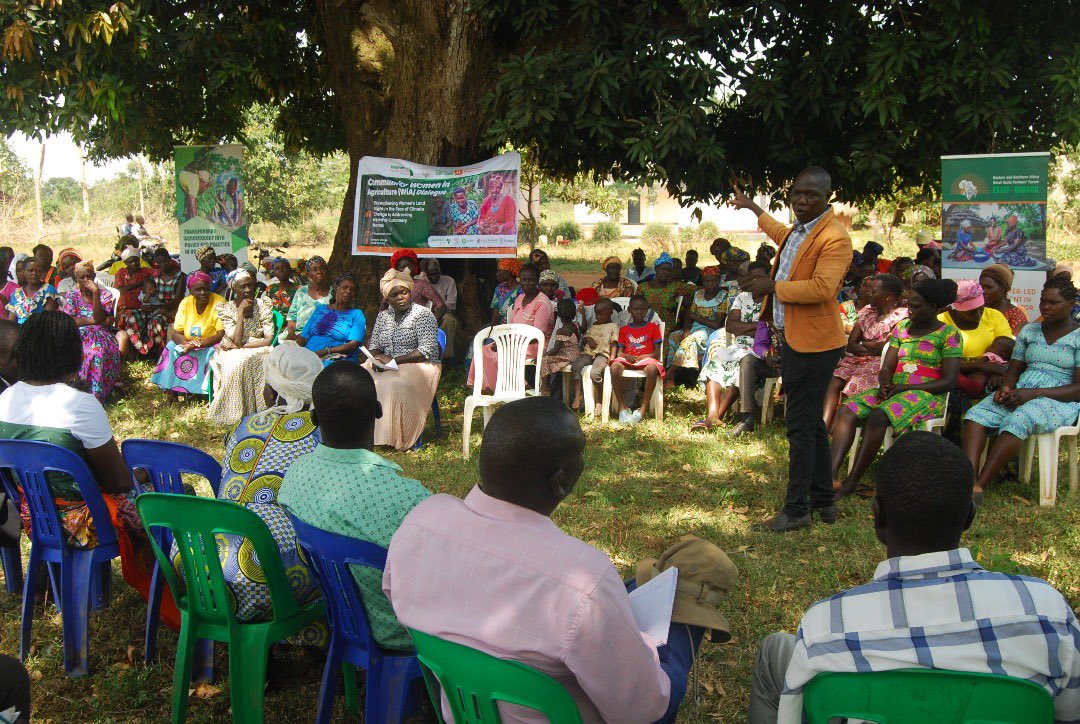
At a community dialogue in Komolo Village, Kumi District, local leaders, agricultural officers, and small-scale farmers raised concerns about customary practices that continue to undermine women’s land rights, health, and livelihoods.
The dialogue, held under the theme, “Strengthening Women’s Land Rights in the Face of Climate Change by Addressing Harmful Customary Norms,” was part of the 16 Days of Activism Against Gender-Based Violence campaign, which draws attention to injustices faced by women and girls.
Kaadami Subccounty Agricultural Officer Anthony Ochepa warned that increased use of agricultural chemicals is harming soils and endangering community health, particularly for women, who constitute the majority of small-scale farmers.
“Chemical use in farming is doing more harm than good. It affects our soils and exposes people to long-term health risks. ESAFF Uganda’s push for ecological farming is timely and extremely important for our communities,” Ochepa said.
He noted that promoting environmentally friendly practices is critical as climate change intensifies food insecurity in the region.
Ochepa also highlighted that many women in Komolo lack knowledge of their land rights. With most couples cohabiting rather than legally marrying, women often have limited legal protection regarding land ownership or inheritance.
“Without clear understanding of their rights, women remain vulnerable, especially in households where land belongs entirely to the man,” he explained.
Small-scale farmer Abraham Ojangole of ESAFF Kumi emphasized the urgency of addressing land ownership issues amid persistent gender-based violence.
He noted that oppressive cultural norms continue to deny women the right to own or control land, even when national laws guarantee equality.
“Holding this dialogue during the 16 Days of Activism was vital. Many women are still denied land because of cultural norms. I call on community leaders and households to embrace laws that give both women and men equal property rights,” Ojangole said.
In Nebbi District, clan leader Geoffrey Okwany, the Rwot of the Kaal Vurr Clan, acknowledged some progress but stressed that traditions still restrict women’s land rights.
“In the past, women were completely excluded from inheriting land. Today, they may receive land from their families, but they are often not permitted to sell it. They can live on it and use it to support their children, but the power to sell remains restricted,” Okwany said.
He stressed that such limitations reflect deeply rooted cultural practices that must be addressed for women to fully enjoy their constitutional rights.
